
I dislike my photo taken, and I rarely show one, but I just wanted to show the other Laura (she knows who she is) that, yes, it did rain on this road trip. The rain, however, was never a big deal.

Appomattox Court House and the surrounding countryside is beautiful and peaceful; a bucolic place that anyone would want to live in.
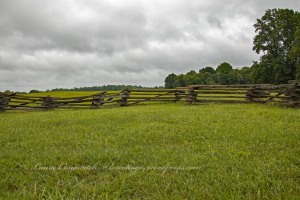
*Clicking on a photo will give you a closer look!
The antebellum village began as Clover Hill. The village was a stop along the Richmond-Lynchburg stagecoach road. It was also the site of organizational meetings, so when Appomattox County was established by an Act on February 8, 1845, Clover Hill village became the county seat.
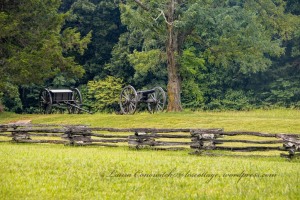
In early April 1865, Confederate States Army forces commanded by General Robert E. Lee were being pursued by Union Army troops commanded by Lieutenant General Ulysses S. Grant.
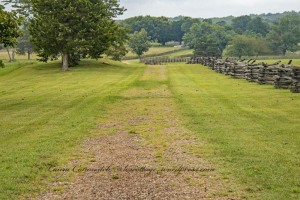
The Richmond-Lynchburg Road was important to Lee’s retreat from Grant. However, the Federals blocked this route, and in spite of Lee’s attacks, his army was surrounded, forcing him to surrender.
“Then there is nothing left for me to do but to go and see General Grant, and I would rather die a thousand deaths.”
Lee formally surrendered to Grant on April 9, 1865 at the Wilmer McLean house in Appomattox. (After the Battle of Bull Run, McLean had moved here to escape the war.)
On April 12, a formal ceremony of parade and the stacking of arms led by Confederate Maj. Gen. John B. Gordon to Federal Brig. Gen. Joshua Chamberlain marked the disbandment of the Army of Northern Virginia.
Nearly 28,000 remaining officers and men were paroled, free to return home without their major weapons, but enabling men to take their horses and officers to retain their sidearms (swords and pistols), and effectively ending the war in Virginia.
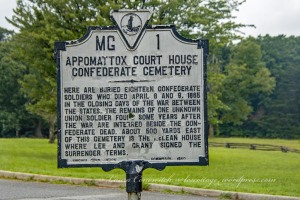
There were perhaps 100 soldiers killed here between April 8 and 9. 19 of those are buried here in Appomattox Court House Confederate Cemetery.
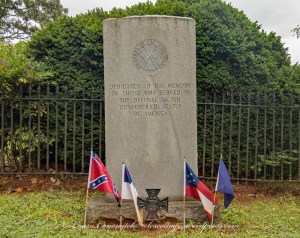
Only 8 of these soldiers are known. Alabamian Private Jesse H. Hutchins enlisted only 5 days after Confederate troops fired upon Fort Sumter. He had survived 1,454 days of service, only to be killed a few yards from the Appomattox Courthouse in the evening of April 8, 1865, just hours before General Lee surrendered the Army of Northern Virginia to General Ulysses S. Grant.
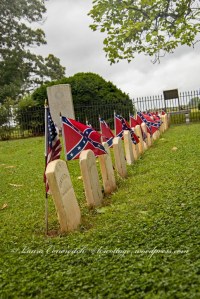
The unidentified Union soldier was found in a wooded lot after the Federal dead had been removed in 1866 and 1867.
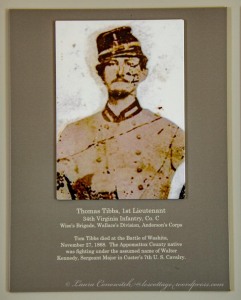
I discovered Thomas Tibbs in the Appomattox Courthouse museum. He stood out to me because he was an Appomattox County native and served in Custer’s U.S. 7th Cavalry. He did not die at the Battle of Little Bighorn, which I have visited twice, but at the Battle of Washita.
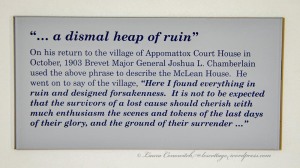
Since 1903, when General Joshua Chamberlain revisited Appomattox Court House, and described the McLean house as a heap of ruins, the house has been reconstructed. I will share that in the next post.
See the world around you!




 LC's Cottage