
Andersonville National Historic Site, Georgia-Part 1
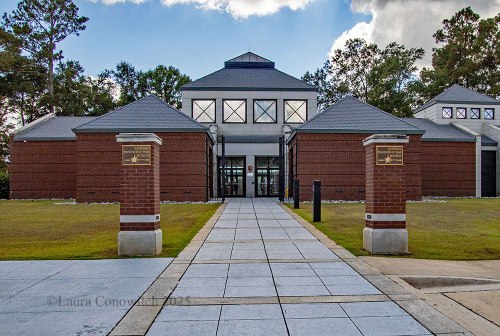
The National Prisoner of War Museum is a memorial to all Americans held as prisoners of war. The exhibits and video presentations within are reminders that freedom comes at a great cost. The museum’s architecture is not based on any one place, but evokes prison towers and stockades in general.
While there are many exhibits pertaining to other wars on display, I am focusing on the Civil War and, in particular, Andersonville Prison. There is much more to the museum than shared in this post.
I will share the grounds of Andersonville Prison in the next post.
Andersonville, or Camp Sumter as it was officially known, was one of the largest Confederate military prisons that existed during the Civil War. The prison site was built in 1864 to relieve the overcrowding of prison sites that resulted from the breakdown of the prisoner exchange system. Camp Sumter was built to hold 10,000 prisoners but confined over 45,000 during the 14 months that it was in operation. Of these, 13,000 prisoners died from disease, poor sanitation, malnutrition, overcrowding, or exposure to the elements and were buried in mass graves on land adjacent to the prison site.
The Code of Conduct – When taken captive, a prisoner of war ceases one battle and begins another, making every effort to resist interrogation, attempt escape, and maintain morale.
‘During the Civil War, the U.S. War Department established that every soldier must try “to rejoin his own side as soon as the opportunity presented itself.” Upheld by soldiers and officers alike during the First and Second World Wars, the duty to attempt escape was codified in 1953, when President Eisenhower issued the first Code of Conduct of Members of the U.S. Armed Forces. As women joined the military in increasing numbers during the 1980s, President Reagan modified the Code of Conduct by removing gender-specific language. If taken captive today, all men and women of the U.S. armed forces are bound by the same oath.’

*Clicking on a photo will give you a closer look!
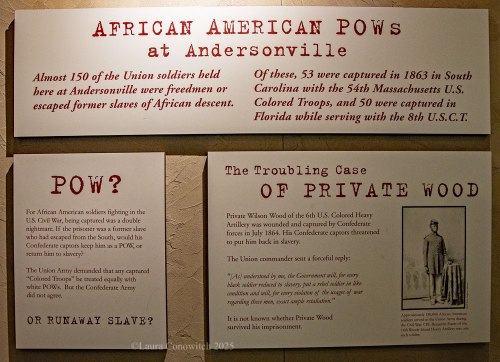
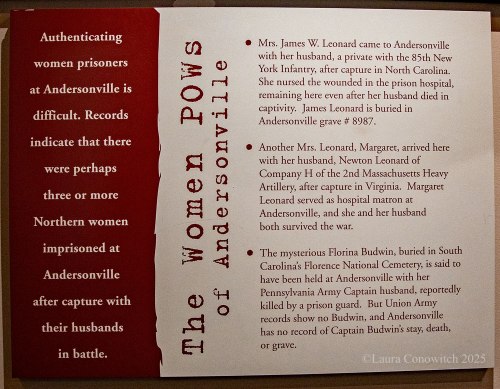
There were civilians confined to Andersonville Prison. You can find them listed in Dorence Atwater’s A list of the Union soldiers buried at Andersonville.


“If, as it has often been remarked that ‘War is the result of a nation’s sins’ – then the sins of this nation must have been very great, and the atonement is truly one of the most painful mortality.” – Unknown POW at Johnson’s Island, Lake Erie

During the Civil War nearly 350,000 soldiers were taken captive and just over 56,000 prisoners died. Of these, 25,796 were Confederates and 30,218 were Union.

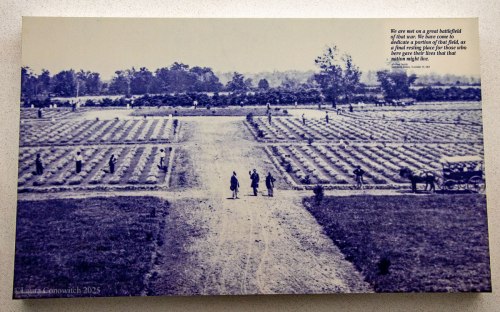
In July and August 1865, a expedition of laborers and soldiers, accompanied by a former prisoner named Dorence Atwater and Clara Barton came to Andersonville to identify and mark the graves of the Union dead and transform the place into the Andersonville National Cemetery. As a paroled prisoner, Atwater was assigned to record the names of deceased Union soldiers. Fearing loss of the death record at war’s end, Atwater made his own copy in hopes of notifying the relatives of some 12,000 dead interred here. Thanks to his list and the Confederates records confiscated at the end of the war, only 460 of the Andersonville graves had to be marked “Unknown US soldier.”


Abraham Lincoln dedicating the Gettysburg National Cemetery.
Brigadier General John H. Winder

John McElroy’s eyewitness account in his 1879 memoir Andersonville depicts Winder as boasting that he was “killing off more Yankees than twenty regiments in Lee’s Army.” McElroy claims that on July 27, 1864, Winder issued an order that if Union troops (under General Stoneman) were to come within seven miles of Andersonville, the guards were to “open upon the Stockade [i.e. upon the prisoners] with grapeshot, without reference to the situation beyond these lines of defense”.
Both the Confederate and Union generals in charge of prisons struggled to feed, clothe, and shelter the prisoners under their care. As the economy of the South fell apart and as Grant refused additional prisoner exchanges, the logistics for caring for Union prisoners reached overwhelming proportions.
Brigadier General William Hoffman

Hoffman, working with President Abraham Lincoln and War Secretary Edwin Stanton, developed a procedure whereby Confederate prisoners of war and deserters could swear allegiance to the Union to gain their release.

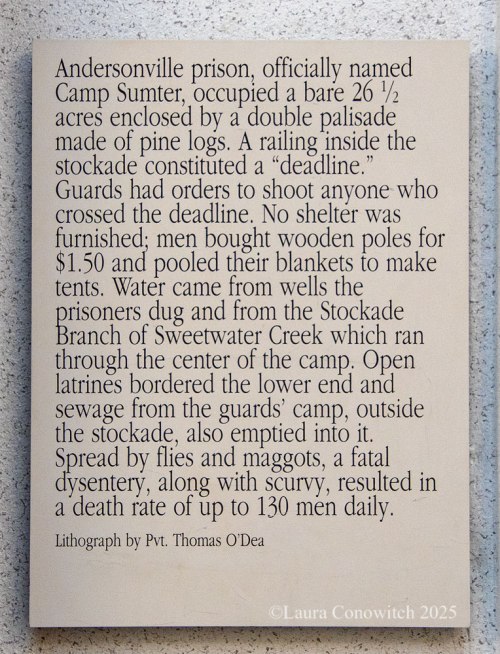
“Ah, my friends, had you been there and experienced the sufferings…you too would have the whole panorama photographed in your memory to remain there to your dying day. – Pvt. Thomas O’Dea, Andersonville prisoner from 1864-1865

The Raiders’ reign and influence was short lived. The first prisoners began to arrive in late February 1864, and gangs that would become the Raiders start to appear in May 1864. By the end of June they were arrested, and the six leaders were hung on July 11, 1864 – a full month before the prison would be at its worst. At the time the Raiders were arrested, there had been fewer than 3,000 deaths in the prison – meaning that some 10,000 prisoners died after the Raiders’ reign ended.

The Raiders leaders were Charles Curtis, John Sarsfield, Patrick Delaney, Teri Sullivan (aka “WR Rickson”, according to other sources), William Collins, and Alvin T. Munn.
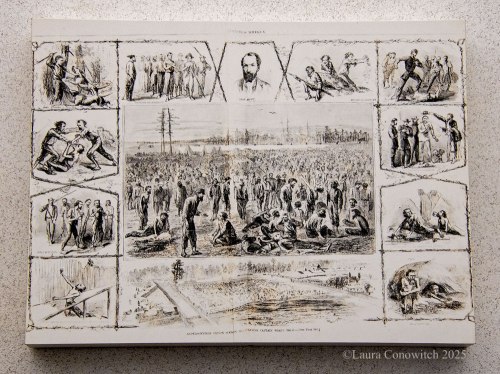
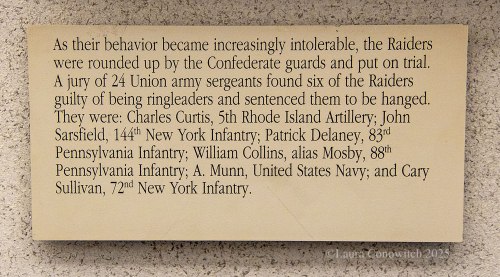
“I would rather be hanged than live the way most prisoners have to live.” – Eyewitness account of Delaney’s last words
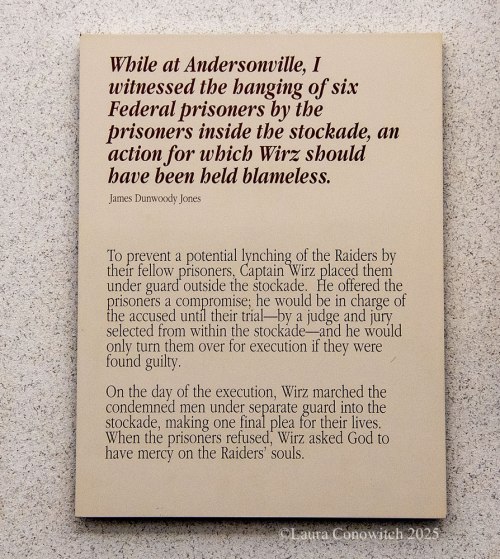
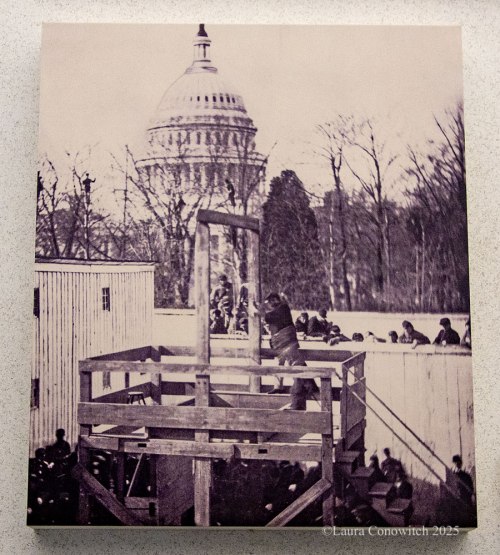
General Lew Wallace was the president of the military commission that tried and convicted Captain Henry Wirz, the commander of the Confederate Andersonville Prison, after the Civil War. Wallace presided over the trial in August 1865, which found Wirz guilty of war crimes related to the horrific conditions at the prison. He was subsequently sentenced to death and hanged in November 1865.



See the world around you!
More Travel Posts:




 LC's Cottage
Our own holocaust on a smaller scale 😩
LikeLike
My thoughts as well.
LikeLike
Pingback: Cross Country Vacation Sept./Oct. 2025-Post 15-Part 2 | LC's Cottage
DH had an uncle (not sure how many greats) that survived Andersonville, only to die in the Sultana explosion on his way home. This camp is a reminder of how ugly war really is. 😦
LikeLike
I am sorry to hear that Kathy. As horrific as this camp was, and so many others, some similar, some worse, I hope that they stand as reminders for future generations. 😓
LikeLike