
Fort Phil Kearny State Historic Site
In Wyoming, an outpost along the Bloody Bozeman Trail was needed to protect freighters, gold seekers, pioneers and settlers as they traveled through the Plains Indian lands. Construction by the United States Army began in the summer of 1866 under the direction of the regimental commander Colonel Henry B. Carrington. The post was named for Major General Philip Kearny (1815–1862), a figure in the Civil War.

*Clicking on a photo will give you a closer look!
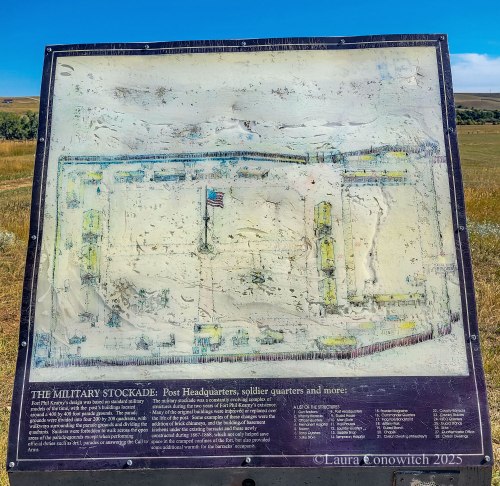
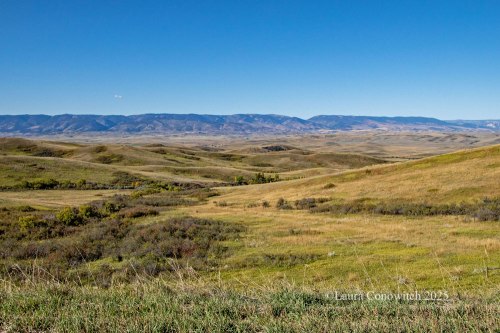

The Hubster and I started our self-guided tour in the interpretive center where we could watch a short video and see maps to orient ourselves to the fort and its history. The staff was very helpful.
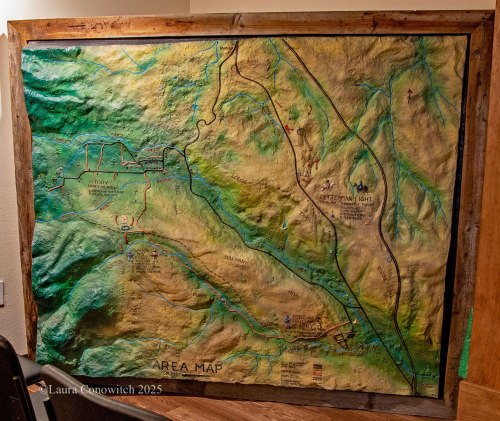

Fort Phil Kearny was the largest of three forts built along the trail and was established on 17 acres. Replacement posts mark the original corners of the 800’ x 600’ stockade.

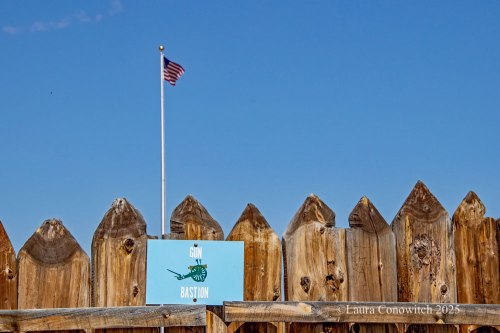
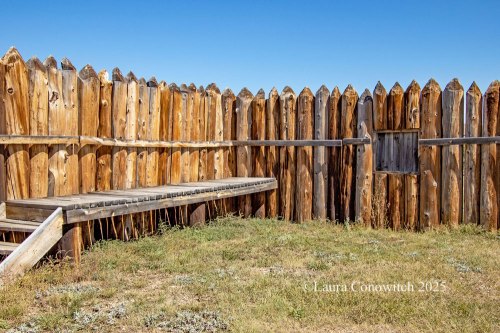
Carrington’s men built over 60 structures of one kind or another and there is plenty of signage to help you visualize what was once here. Sawmills, surgeons, chaplains, officers row, post headquarters, post commander’s quarters, storing munitions, civilian quarter, storage buildings, commissary, laundress row, guard house, sutler’s house, band quarters, hospital, enlisted men quarters and more.


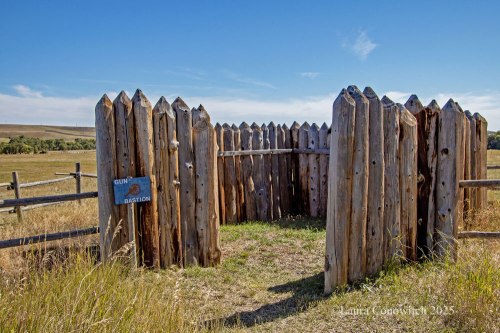
Two major battles, the Fetterman fight and the Wagon Box fight, occurred near the fort along with numerous smaller skirmishes.
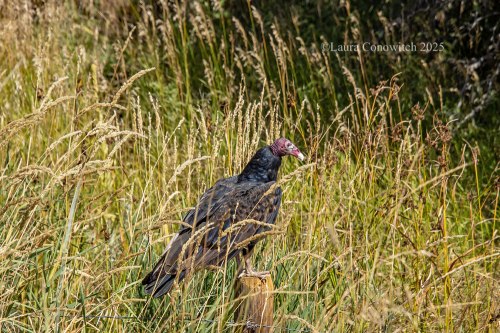
The Fetterman fight (also known as Battle of the Hundred-in-the-Hands), December 21, 1866, resulted when Capt. William Fetterman allowed himself and his troops to be lured over a hill, called Lodge Trail Ridge, north of the fort and outside of supportive distance from Fort Phil Kearny. It was one of only a few battles in U.S. history in which an entire command was wiped out. 76 enlisted men, three officers and two civilians, were killed by Cheyenne, Arapaho and Sioux warriors and shocked the nation. At the time, it was the worst military defeat ever suffered by the Army on the Great Plains.
From this battle the warriors learned that if they could lure a large military command over the ridge they could be wiped out. Carrington learned he could not support a unit north of Lodge Trail Ridge.
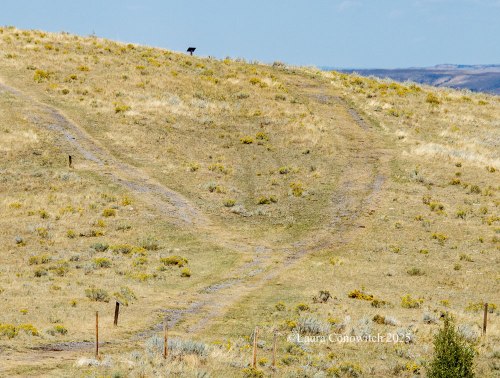
You can walk this ridge and and gain a sense of time and place. Those two lines in the photo above are remnants of the Bozeman Trail between the loop trail that you can hike.

Inside the wall are the rocks where the bodies of Brevet Lt. Col. Fetterman and Capt. Brown were found on that cold and bitter day of December 21, 1866.
From the website:
The story of Adolph Metzger is one of the battle’s most intriguing. The accounts of 2 soldiers who were among those sent out to the site of the battle to gather the bodies of the Fetterman dead, along with accounts in Indian battle participant’s interviews with Judge Eli Ricker seem to confirm that Metzger fought hard with his bugle as a weapon. American Horse testified that Metzger’s bravery was honored by the Indians by sparing his body the mutilations which befell others and by placing a buffalo bag, or robe, over his head to honor him.

The stockade was built of pine logs cut and hauled from about 6 miles northwest. A train of up to 90 wagons was employed to haul logs. Blockhouses were constructed on Piney Island for protection. The stockade was of heavy logs, 11 ft. long, side-hewn, placed 3 ft. into the ground and standing 8 ft. high.
The following photo shows the hills where the trees were cut from. In other words, those bare hills used to be a forest of pines…Piney Hills.
Wagon trains of woodcutters and their soldier guards suffered constant small attacks during the entire two years Fort Phil Kearny was in existence. In early July, a corral of wagon boxes was built to protect stock from being run off by the Indians and protect the contracted civilian woodcutters. Fourteen boxes were placed end to end in an oval about 70′ wide x 100′ long, with space between wide enough for a man. Supplies were stored in three of the wagons, and soldiers and civilians slept in tents outside the enclosure.

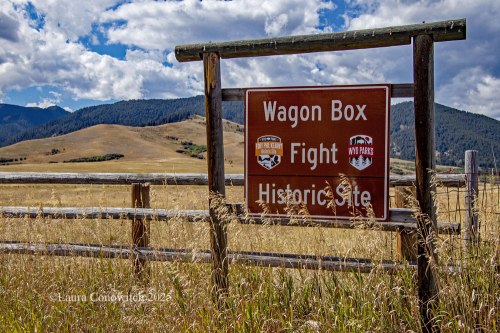
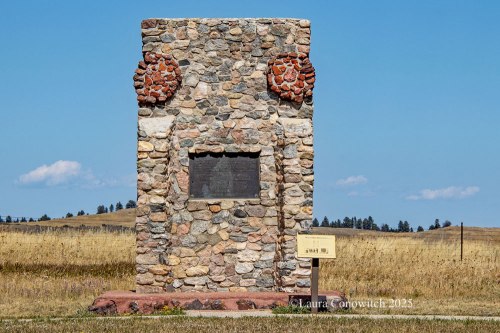
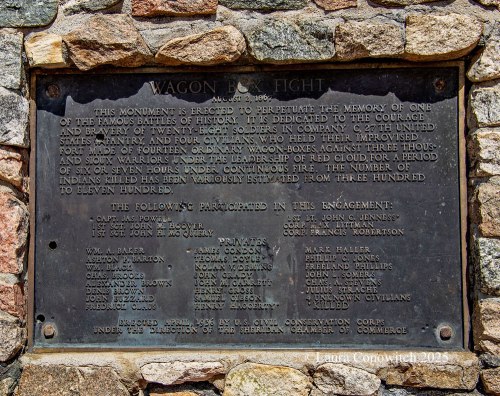
August 2nd 1867, The Wagon Box Fight, a few miles west of Fort Phil Kearny, developed when 32 woodcutters and guards were attacked by the forces of Oglala Chief Red Cloud. It was the first time a large force of mounted tribesmen faced sustained fire from relatively rapid-shooting, breech-loading rifles. The Indians were primarily armed with bows and arrows, lances and war clubs, though some had firearms captured months earlier during the Fetterman attack. They didn’t have much ammunition, however. The soldiers at the Wagon Box Fight began the battle with 7,000 rounds on hand—and this large supply saved their lives. The warriors’ tactics of closing fast on horseback for close combat with their enemies no longer worked—and they paid a heavy price.

With Indian harassment continuing, the Trail was closed to all civilian travel after the Fetterman Fight. With massive logistical problems of servicing an army so far from supply bases and the transcontinental railroad nearing completion, the Bozeman Trail was soon obsolete.

See the world around you!
More Travel Posts:




 LC's Cottage
I remember stopping at this site however we never did do such an in-depth look see. Thank you for showing me my world around me 🙂
LikeLike
Thank you Sharon…fun to know that I refreshed your memory! 🙂
LikeLike
Thank you Sharon…fun to know that I refreshed your memory! 🙂
LikeLike
Enjoying your ‘series’… 🙂
LikeLike
Thank you Laura! 🙂
LikeLiked by 1 person
Such a fascinating area! Our son enjoys visiting historical sites like you’re doing – I’m going to tell him about these. Looks like you had great weather for your trip, too!
LikeLike
We had great weather for the entire month that we traveled, Diann! So blessed!
I hope your son will be able to visit as many historical sites as he can! The Hubster and I sure enjoy them, and learn a lot, too!
Still playing ‘catch up’ now that I am home. 🙂
LikeLike
Pingback: Cross Country Vacation Sept./Oct. 2025-Post 3 | LC's Cottage
Pingback: Cross Country Vacation Sept./Oct. 2025-Post 4 | LC's Cottage
Pingback: Cross Country Vacation Sept./Oct. 2025-Post 5 | LC's Cottage
Pingback: Cross Country Vacation Sept./Oct. 2025-Post 6 | LC's Cottage
Pingback: Cross Country Vacation Sept./Oct. 2025-Post 7 | LC's Cottage
Pingback: Cross Country Vacation Sept./Oct. 2025-Post 8 | LC's Cottage
Pingback: Cross Country Vacation Sept./Oct. 2025-Post 9 | LC's Cottage
Pingback: Cross Country Vacation Sept./Oct. 2025-Post 10 | LC's Cottage
Pingback: Cross Country Vacation Sept./Oct. 2025-Post 11 | LC's Cottage
The range of travel the Lakota Chiefs did back then was amazing to me. I know those chief’s names from my work on Pineridge, which is on the Nebraska border! Fascinating!
LikeLike
I know where Pineridge is, Kathy!
Since visiting Fort Philip Kearney, I have read a book by his second wife, who lost her husband in the Fetterman Battle, and married Commander Carrington after his first wife died. This woman is amazing. She grew up on a plantation with slaves, married the military life, moved to the frontier and experienced Indian wars and lived through the industrial age…the invention of the automobile. Talk about life experiences! 🙂
My Army Life and the Fort Phil Kearney Massacre by Frances C. Carrington
LikeLiked by 1 person
That sound like a great read!
LikeLike
It is if you enjoy history. 🙂
LikeLike