
The Hubster and I were looking for a place to have a picnic lunch. Little did we know that we were stepping into such an important part of westward expansion.
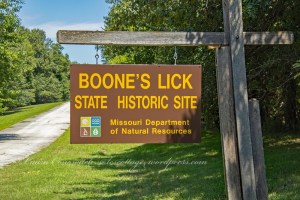
Three families, the Mackays, the Boones, and the Morrisons, along with a few others, turned a saline lick into a commercial enterprise that helped shape the Louisiana/Missouri Territory.
The Boonslick Road originally ended in Howard County, Missouri, where the Boones’ salt works is now a Missouri State Historic Site. After this road was extended westward from Howard County, the old Boonslick Road would become the Santa Fe Trail. This ancient thoroughfare later became U.S. Highway 40 and finally modern Interstate 70.
*Clicking on a photo will give you a closer look!
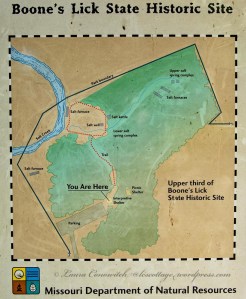
What is a salt lick? It is a briny spring where animals come to lick the ground. Approximately one -third of Missouri contains saline waters.
Salt was the main means of food preservation.

Boone’s Lick was not discovered by Daniel Boone as the following marker says. James Mackay was granted the land by the Spanish in 1797.

By 1804, Daniel Morgan and his brother, Nathan Boone were in partnership with Jesse and James Morrison.
There are many sign boards here where one can read about the history of the area. They are very informative.
If this period in American history interests you, then on page 2 of the Boonslick Historical Society Periodical, there is an excellent map detailing the Morrison commercial empire.
The Hubster and I took a short hike to see what was left of the salt lick.
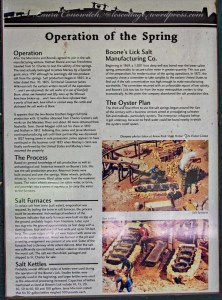
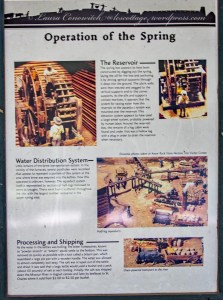
It is very overgrown and very pretty.


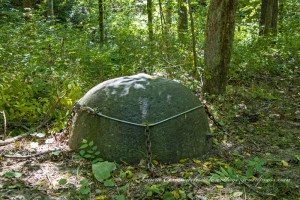
There is not much remaining, but one can see a large kettle used to boil the saltwater.
There is one grave marker here at Boones Lick.
It is the grave of Joseph L. Morrison, the son of Major James. Joseph somehow fell into a boiling kettle and was horribly scalded. It is said that he survived for a couple of days. He was 11 years old (16 years say some accounts).


See the world around you!




 LC's Cottage