
Monterey Square, Savannah, Georgia
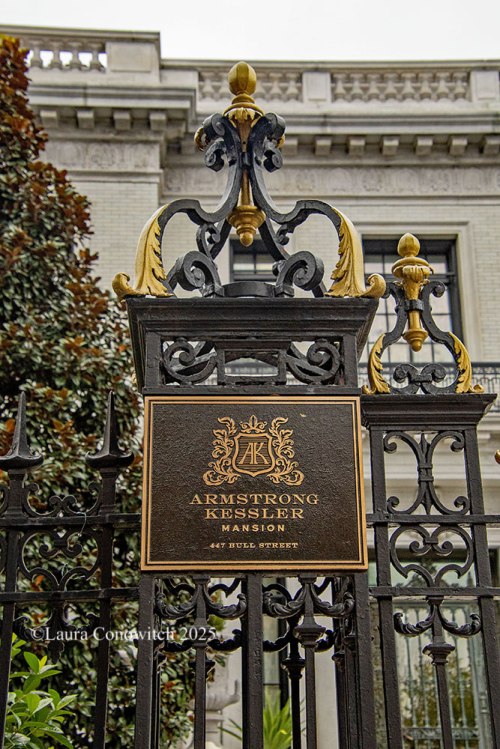
The Hubster and I took a walk in parts of Savannah and enjoyed taking in the archictecture and sights of the area that we were in. We passed by the very ornate Armstrong Kessler Mansion on our walk in the historic district.
*Clicking on a photo will give you a closer look!
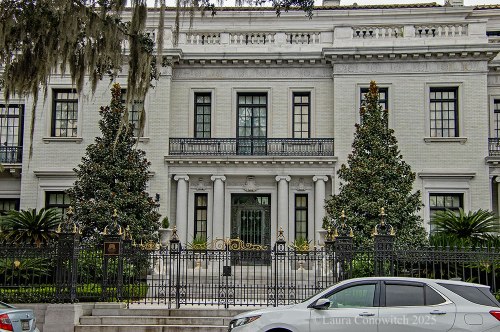
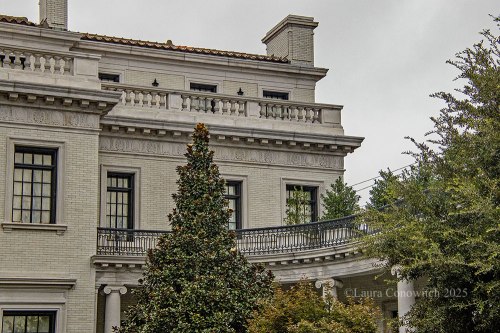


Monterey Square was laid out in 1847 and commemorates the 1846 Battle of Monterey during the Mexican American War.
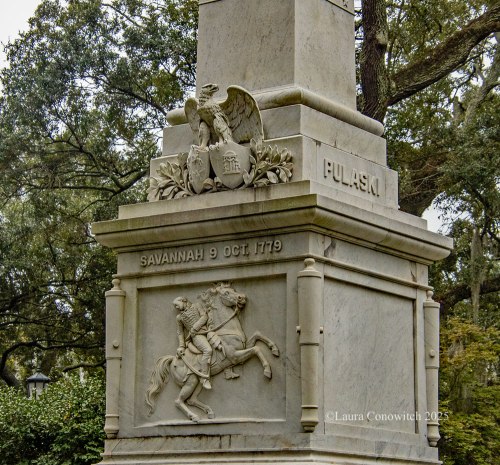
The Casimir Pulaski Monument in the center of the square honors General Pulaski. The monument was erected in 1853. During the Siege of Savannah in the American Revolution, October 1779, the young Polish nobleman died as a result of a gunshot wound. The body of an unknown Revolutionary soldier, speculated by some to be General Pulaski himself, is said to be buried beneath the monument. There have been several tests, including DNA, that make for a very good case that this is Pulaski, but there is still controversy. There is also controversy as to whether Pulaski was male or female.

“I came here, where freedom is being defended, to serve it, and to live or die for it.” – General Casimir Pulaski to General George Washington in 1777.

The designer of the monument, which is of Italian marble, was the eminent Russian-born sculptor, Robert Eberhard Launitz of New York. At the conclusion of his explanation of the elaborate design and its symbolism Mr. Launitz stated:
“The monument is surmounted by a statue of Liberty, embracing with her left arm the banner of the Stars and Stripes, while in her right hand is extended the Laurel Wreath. The love of liberty brought Pulaski to America; for love of liberty he fought, and for liberty he lost his life. Thus, I thought that Liberty should crown his monument, and share with him the homage of the free.”

The Greek and Italian style Mercer-Williams House was designed by John S. Norris and erected in 1871. It was commissioned by General Hugh W. Mercer, grandfather of the renowned songwriter Johnny Mercer, in the year 1860.
Mercer-Williams House has been surrounded by mystery and death. In 1913, the owner at that time tripped over the second floor banister, suffering only mild injuries but strangely died three days later. Later on in 1969, a young boy chasing pigeons on the roof fell over the edge and impaled himself on the iron fence below. The story, ‘Midnight in the Garden of Good and Evil’ by John Berendt, revolves around this house (I have the book but haven’t read it yet). The book, was published in 1994 and follows the story of Jim Williams, an American antiques dealer and a historic preservationist, on trial for the killing of his lover, Danny Hansford. After four trials, Williams was acquitted of Hansford’s murder.
The house showcases Philadelphia red brick facade with elegant cast iron balconies and French windows as well as eight balconies and forty windows throughout its impressive structure. Inside the house is a large, eclectic collection of original paintings, furniture, and art pieces, including 18th and 19th century English and American portraits and Chinese porcelain.
The Hubster and I took a tour of this home, but we were not allowed to take photos. I can say that we enjoyed the tour of this beautiful home and the garden.

“What I enjoy most,” he said, “is living like an aristocrat without the burden of having to be one.” – Jim Williams
The Comer Mansion on Monterey Square, formerly the home of Hugh Moss Comer , President of the Central of Georgia Railway, was built in 1880.
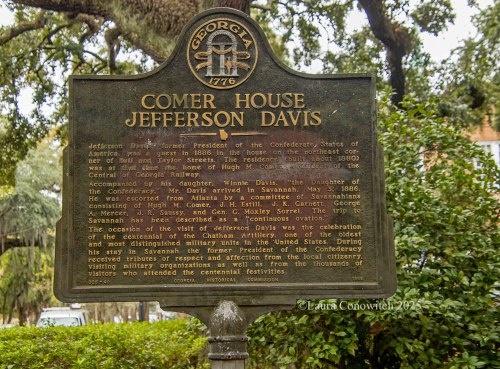
The house is notable for its elegant architecture and its role in hosting distinguished Confederate dignitaries during the late 19th century.
In 1886, Jefferson Davis, former president of the Confederate States of America, with his daughter Varina Anne Davis, resided here while celebrating the centennial of Savannah’s Chatham Artillery.

The Gothic Revival Green-Meldrim Mansion was designed by John S. Norris and built by Charles Green, one of Savannah’s richest cotton merchants, in 1850. It has a stuccoed brick exterior, cast-iron porch, oriel windows, and an imposing front cast-iron fence. The main entrance has an iron portico believed to be unique in the United States.
After the Union troops captured Savannah in 1864, and at the invitation of Charles Green, General Sherman occupied the house and used it as his personal headquarters until the end of the Civil War. In December, Sherman composed his telegram to President Lincoln, in which he communicated his desire to present to the President “as a Christmas Gift the City of Savannah, with one hundred and fifty heavy guns and plenty of ammunition, and also about twenty-five thousand bales of cotton”; the cotton belonged to Charles Green, the owner of the house.

Susie Baker King Taylor, born into slavery in 1848, later a freed African American woman who worked for the Green family, was the first and only woman to publish accounts of the Civil War.
She is known for being the first African-American nurse during the American Civil War, the first Black woman to self-publish her memoirs (She was the author of Reminiscences of My Life in Camp with the 33rd United States Colored Troops, Late 1st S.C. Volunteers – 1902.), and as an educator to formerly bonded Black people in the Reconstruction-era South when she opened various Freedmen’s schools for them.


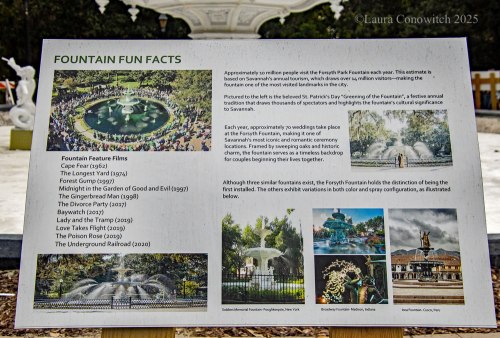
Forsyth Park, Savannah’s oldest and largest park at 30 acres, was fun to walk about. There were artisans of all types; jewelry makers, painters, fortune tellers, and so many more, lining the walkways around the Fountain. There were people jogging, dog walking, and picnicking. There were the sight-seers, like myself.
A busy and happy place!

Unfortunately, for our visit, the Forsyth Park Fountain was undergoing preservation and restoration, and we did not get to see it in all of its glory. The fountain is over 150 years old! It was originally built to provide clean drinking water to the citizens of Savannah.

Originally known as the Confederate Monument, the Civil War Memorial stands at 48 feet tall and is topped with a bronze statue of a Confederate soldier. It was dedicated in 1875 to honor Confederate soldiers who died during the Civil War.
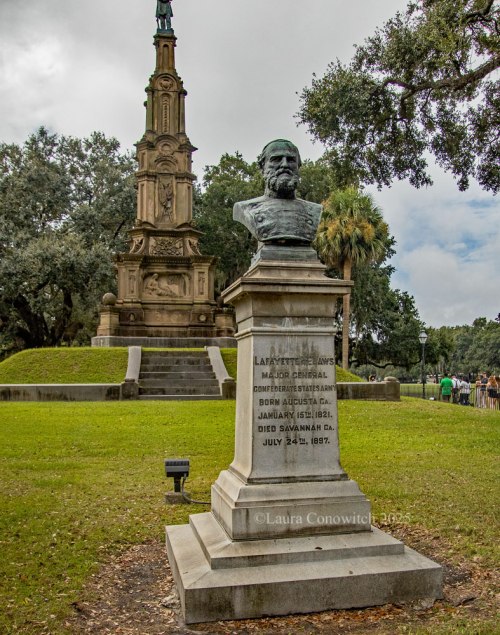
In 1910, two bronze busts honoring Confederate generals Lafayette McLaws and Francis S. Bartow were moved next to the monument.
The Ladies Memorial Association, in charge of the monument, and raising the funds for the monument, unanimously decided that the memorial must not arrive from the northern United States: tensions between the American North and South were still high, and a monument commissioned to a northerner felt inappropriate. They also did not allow the use of Northern ports. The Ladies Memorial Association also determined Forsyth Park as the location for the monument.
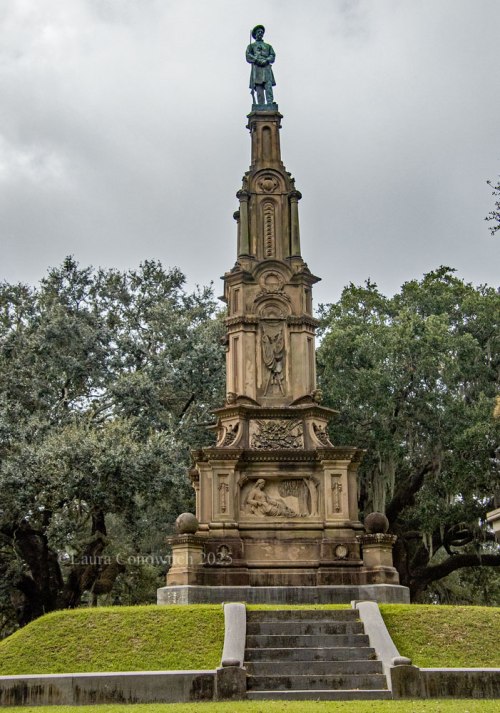
There was considerable controversy over the design of the monument. Many did not like the symbolism and funerary elements and considered it artistically offensive. Changes to the original design were made, including changing the name from the Confederate Monument to the Civil War Memorial.

“Blow from the four winds, o breath, and breathe upon these slain that they may live.” – Inscription

See the world around you!
More Travel Posts:




 LC's Cottage