Tag Archives: Georgia

Cross Country Vacation Sept./Oct. 2025-Post 15

Andersonville National Historic Site, Georgia-Part 2

In my last post, I shared some of the exhibits you can find in the National Prisoner of War Museum at the Andersonville National Historic Site.

I will share some of the grounds of Andersonville Prison in this post. However, if you haven’t seen my last post, I strongly suggest reading it first, as much of what occurred here is shared there.

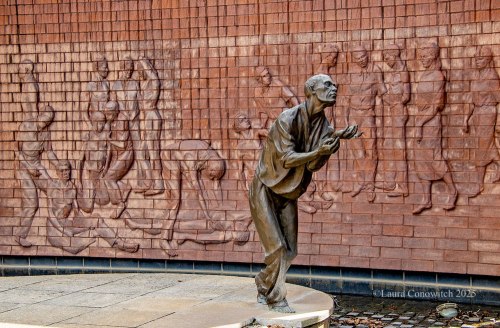
The Memorial Courtyard at the rear of the museum displays a meandering stream recalling the water themes common to many POW experiences, and a major brick and bronze sculpture.

Andersonville National Historic Site, Georgia

It is meant to be a place of contemplation.
Andersonville National Historic Site, Georgia

*Clicking on a photo will give you a closer look!

Andersonville National Historic Site, Georgia

Behind the Memorial Courtyard are the grounds of Andersonville Prison.

You can get a brochure from the visitor’s center. I suggest watching the films, and viewing the exhibits in the center before walking the grounds. There are signs everywhere, but you will feel more oriented if you visit the museum first.

Andersonville National Historic Site, Georgia

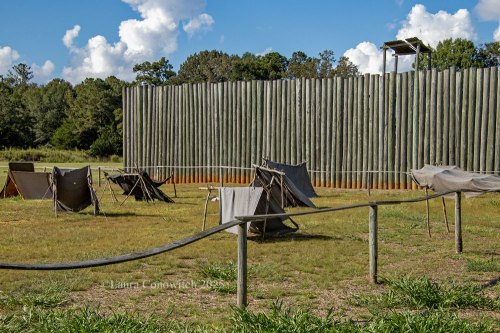
Replicas of tents that prisoners used for shelter. Many prisoners had no shelter, or even proper clothing, to shield them from the elements.
Andersonville National Historic Site, Georgia

Successful escape from Andersonville was virtually impossible, and it was much rarer than what has often been portrayed. Even most of those who managed to successfully escape from Andersonville did so between the Fall of 1864 through the Spring of 1865, when the prison and its security systems were breaking down as the war ended.

Escape from Camp Sumter (Andersonville) had an extremely high rate of failure. For a Union prisoner to make a successful attempt for freedom from the prison compound, he had to make it past stockade walls, guards, artillery surrounding the stockade, local militia, citizen mobs, and patrols with tracking hounds. Patrols for Confederate deserters and escaped slaves often caught escaped prisoners, sending dozens of men back to the stockade.

Andersonville National Historic Site, Georgia

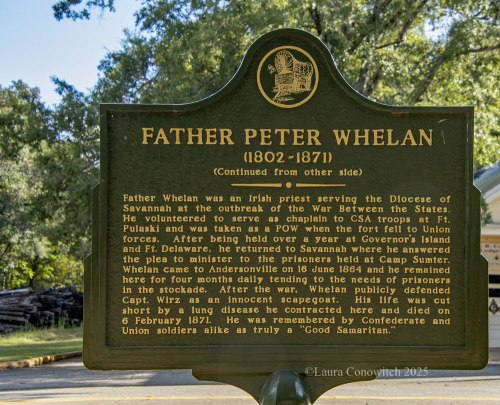
When the prisoners returned home and wrote their memoirs, Father Whelan and his work was often recalled. Some mentioned that he had brought clothing, food, and money from Savannah. One added, “without a doubt he was the means of saving hundred of lives.” Another described Whelan’s ministering to the sick: “All creeds, color and nationalities were alike to him…He was indeed the Good Samaritan.” A sergeant, John Vaughter, in his memoirs remarked that, “of all the ministers in Georgia accessible to Andersonville, only one could hear this sentence, ‘I was sick and in prison and you visited me,’ and that one is a Catholic.”

After Father Whelan’s departure in late September, he borrowed $16,000 in Confederate money, the equivalent of $400 in gold, and purchased ten thousand pounds of wheat flour. He had it baked into bread and distributed at the prison hospital at Andersonville. It was enough bread to provide for the men for several months.
Andersonville National Historic Site, Georgia

Clara Barton Monument

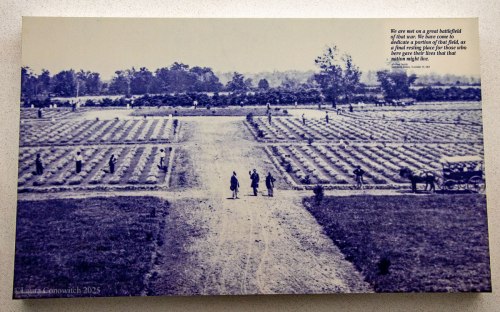
Clara Barton, the “Angel of the Battlefield”, nurse, humanitarian, founder and first president of the American Red Cross, spent the summer of 1865 helping find, identify, and properly bury 13,000 individuals who died in Andersonville prison camp.

In Commemoration of the Untiring Devotion of
Clara Barton


She organized and administered efficient measures for the relief of our soldiers in the field, and aided in the great work of preserving the names of more than twelve thousand of the brave men who died here.

Erected 1915 by Woman’s Relief Corps, Auxiliary to the Grand Army of the Republic.

Andersonville National Historic Site, Georgia

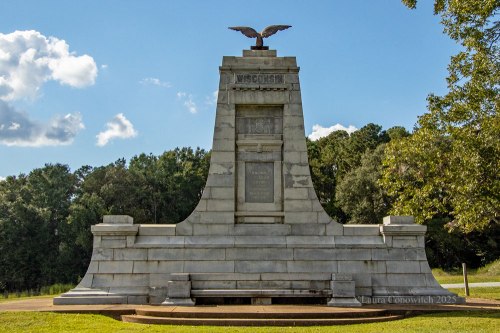
Wisconsin Monument

Let Us Have Peace

Andersonville National Historic Site, Georgia

Massachusetts Monument

“Death Before Dishonor”

Andersonville National Historic Site, Georgia

Tennessee Monument

Andersonville National Historic Site, Georgia

Michigan Monument

Andersonville National Historic Site, Georgia

There are other monuments at Andersonville than the few that I have shared in this post.

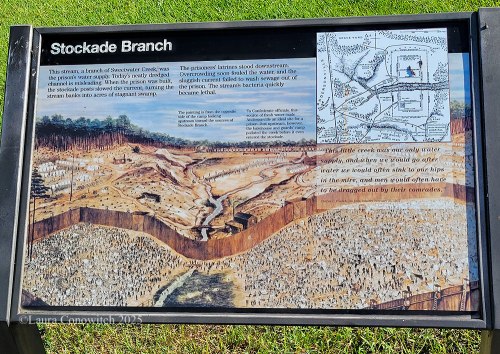
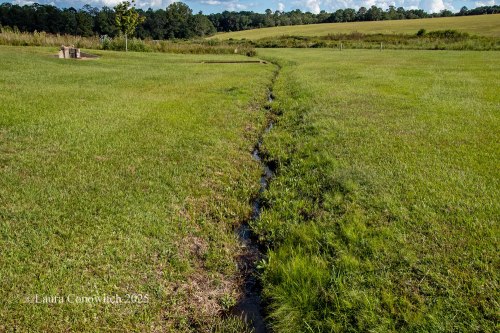
The prisoners’ water source, the Stockade Branch, a branch of Sweetwater Creek, was contaminated with human waste and oils from the Confederate guards’ camp before it even got to the prisoners.
Andersonville National Historic Site, Georgia

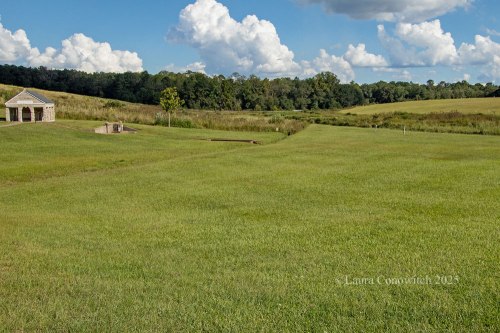
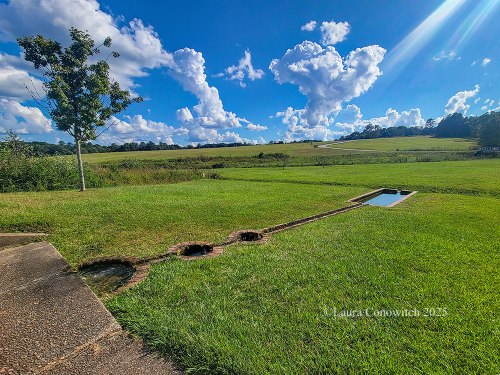
“A spring of purest crystal shot up into the air in a column and, falling in a fanlike spray, went babbling down the grade into the noxious brook. Looking across the dead-line, we beheld with wondering eyes and grateful hearts the fountain spring.” – John L. Maile, 8th Michigan Infantry August 15, 1864.
Andersonville National Historic Site, Georgia

Andersonville National Historic Site, Georgia

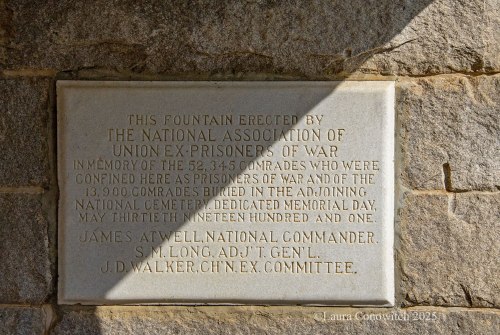
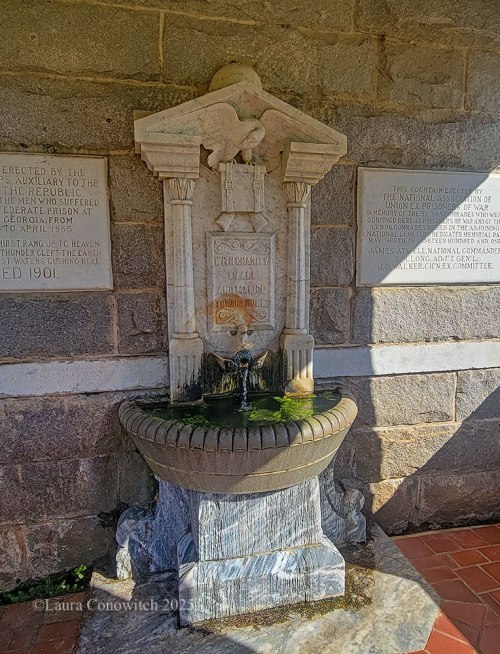
The miracle stream of water was named Providence Spring.
Andersonville National Historic Site, Georgia

Andersonville National Historic Site, Georgia

Providence Spring House

Andersonville National Historic Site, Georgia

Andersonville National Historic Site, Georgia

Andersonville National Historic Site, Georgia

Anderson was named for John Anderson, a director of the South Western Railroad in 1853 when it was extended from Oglethorpe to Americus. It was known as Anderson Station until the US post office was established in November 1855. The government changed the name of the station from “Anderson” to “Andersonville” in order to avoid confusion with the post office in Anderson, South Carolina.

The town also served as a supply depot during the war period. It included a post office, a depot, a blacksmith shop and stable, a couple of general stores, two saloons, a school, a Methodist church, and about a dozen houses. Ben Dykes, who owned the land on which the prison was built, was both depot agent and postmaster.

Andersonville National Historic Site, Georgia

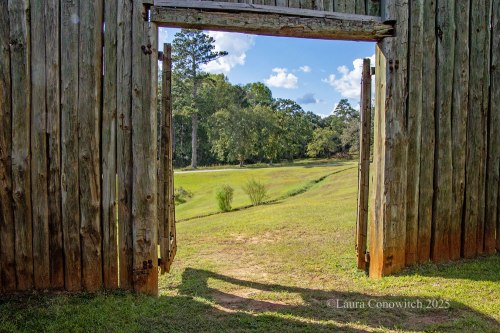
“Then came the captives, weary, worn and hungry from prolonged travel cooped up like beasts in freight cars. Down from the depot they marched amid the jeers and taunts of a gaping crowd. The gate opened. The stockade swallowed them.” – Lessel Long, 13th Indiana Infantry, February 21, 1864

Andersonville National Historic Site, Georgia

“Once inside…men exclaimed: ‘Is this hell?’ Verily, the great mass of gaunt, unnatural-looking beings, soot-begrimed, and clad in filthy tatters, that we saw stalking about inside this pen looked, indeed, as if they might belong to a world of lost spirits.”
W.B. Smith, 14th Illinois Infantry
October 9, 1864.
Andersonville National Historic Site, Georgia

Andersonville National Historic Site, Georgia

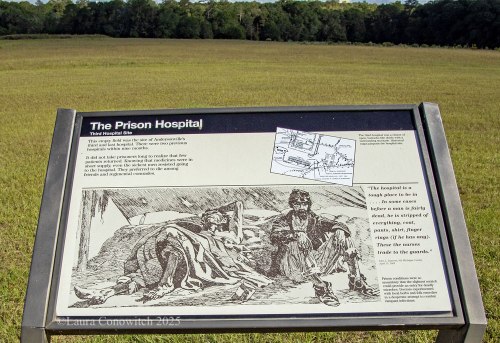
“The hospital is a tough place to be in….In some cases before a man is fairly dead, he is stripped of everything, coat, pants, shirt, finger rings (if he has any). These nurses trade to the guards.”
John L. Ransom, 9th Michigan Cavalry
April 15, 1864
Andersonville National Historic Site, Georgia

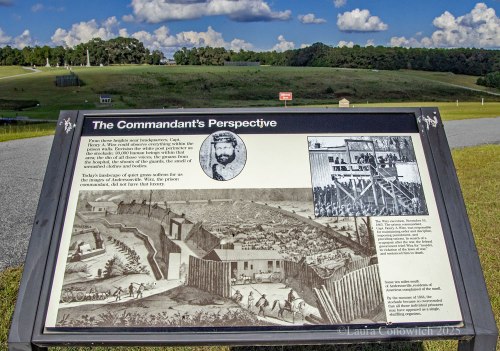
From these heights near headquarters, Capt. Henry A. Wirz could observe everything within the prison walls. Envision the white post perimeters as the stockade; 30,000 human beings within that area; the din of all those voices, the groans from the hospital, the shouts of the guards, the smell of unwashed clothes and bodies.
Andersonville National Historic Site, Georgia

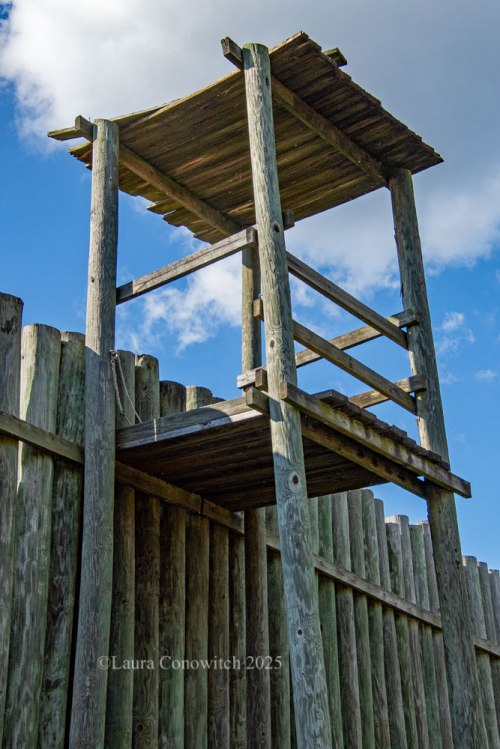
The guards—mostly old men and young boys from the Georgia Reserve Corps—were reluctant witnesses to the misery at Andersonville. More seasoned troops were sent to stop Sherman’s drive toward Atlanta.

Andersonville National Historic Site, Georgia

Pigeon Roosts

Andersonville National Historic Site, Georgia

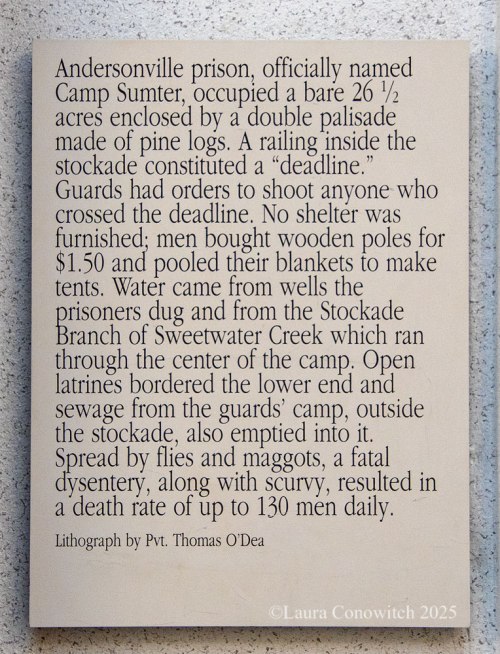
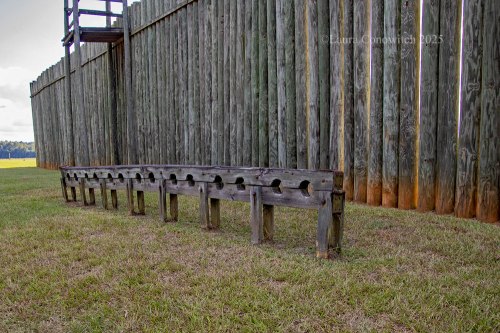
Forms of punishment at Andersonville included death, “bucking and gagging,” hanging up by the thumbs, and physical punishment like whipping for offenses such as stealing. The prison’s harsh conditions and severe overcrowding also acted as a de facto punishment, leading to widespread death from disease and malnutrition. Additionally, guards had orders to shoot any prisoner who crossed the “dead line” or spoke to a sentinel.
Andersonville National Historic Site, Georgia

Firsthand Account of Private Prescott Tracy, Civil War POW

See the world around you!

More Travel Posts:
Cross Country Vacation Sept./Oct. 2025-Post 14

Andersonville National Historic Site, Georgia-Part 1

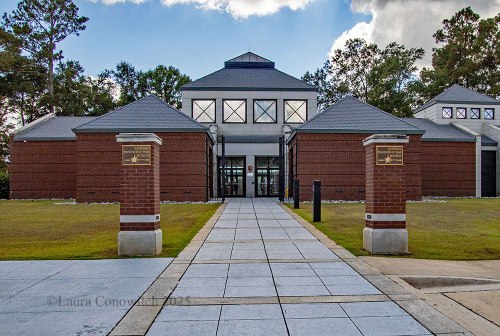
The National Prisoner of War Museum is a memorial to all Americans held as prisoners of war. The exhibits and video presentations within are reminders that freedom comes at a great cost. The museum’s architecture is not based on any one place, but evokes prison towers and stockades in general.

While there are many exhibits pertaining to other wars on display, I am focusing on the Civil War and, in particular, Andersonville Prison. There is much more to the museum than shared in this post.

I will share the grounds of Andersonville Prison in the next post.

Andersonville, or Camp Sumter as it was officially known, was one of the largest Confederate military prisons that existed during the Civil War. The prison site was built in 1864 to relieve the overcrowding of prison sites that resulted from the breakdown of the prisoner exchange system. Camp Sumter was built to hold 10,000 prisoners but confined over 45,000 during the 14 months that it was in operation. Of these, 13,000 prisoners died from disease, poor sanitation, malnutrition, overcrowding, or exposure to the elements and were buried in mass graves on land adjacent to the prison site.

Andersonville National Historic Site, Georgia

The Code of Conduct – When taken captive, a prisoner of war ceases one battle and begins another, making every effort to resist interrogation, attempt escape, and maintain morale.

‘During the Civil War, the U.S. War Department established that every soldier must try “to rejoin his own side as soon as the opportunity presented itself.” Upheld by soldiers and officers alike during the First and Second World Wars, the duty to attempt escape was codified in 1953, when President Eisenhower issued the first Code of Conduct of Members of the U.S. Armed Forces. As women joined the military in increasing numbers during the 1980s, President Reagan modified the Code of Conduct by removing gender-specific language. If taken captive today, all men and women of the U.S. armed forces are bound by the same oath.’

Andersonville National Historic Site, Georgia

*Clicking on a photo will give you a closer look!

Andersonville National Historic Site, Georgia

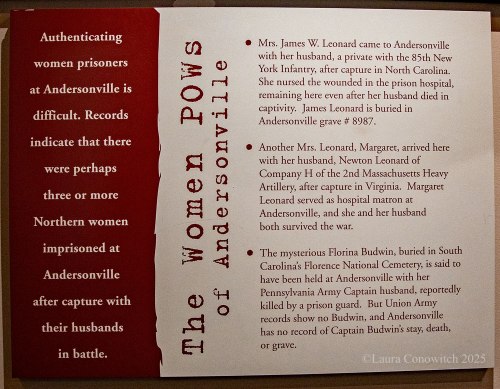
There were civilians confined to Andersonville Prison. You can find them listed in Dorence Atwater’s A list of the Union soldiers buried at Andersonville.

Andersonville National Historic Site, Georgia

Andersonville National Historic Site, Georgia

Andersonville National Historic Site, Georgia

“If, as it has often been remarked that ‘War is the result of a nation’s sins’ – then the sins of this nation must have been very great, and the atonement is truly one of the most painful mortality.” – Unknown POW at Johnson’s Island, Lake Erie

Andersonville National Historic Site, Georgia

During the Civil War nearly 350,000 soldiers were taken captive and just over 56,000 prisoners died. Of these, 25,796 were Confederates and 30,218 were Union.

Andersonville National Historic Site, Georgia

In July and August 1865, a expedition of laborers and soldiers, accompanied by a former prisoner named Dorence Atwater and Clara Barton came to Andersonville to identify and mark the graves of the Union dead and transform the place into the Andersonville National Cemetery. As a paroled prisoner, Atwater was assigned to record the names of deceased Union soldiers. Fearing loss of the death record at war’s end, Atwater made his own copy in hopes of notifying the relatives of some 12,000 dead interred here. Thanks to his list and the Confederates records confiscated at the end of the war, only 460 of the Andersonville graves had to be marked “Unknown US soldier.”

Andersonville National Historic Site, Georgia_Clara Barton

Andersonville National Historic Site, Georgia

Andersonville National Historic Site, Georgia

Andersonville National Historic Site, Georgia

Abraham Lincoln dedicating the Gettysburg National Cemetery.

Andersonville National Historic Site, Georgia

Brigadier General John H. Winder

Andersonville National Historic Site, Georgia

John McElroy’s eyewitness account in his 1879 memoir Andersonville depicts Winder as boasting that he was “killing off more Yankees than twenty regiments in Lee’s Army.” McElroy claims that on July 27, 1864, Winder issued an order that if Union troops (under General Stoneman) were to come within seven miles of Andersonville, the guards were to “open upon the Stockade [i.e. upon the prisoners] with grapeshot, without reference to the situation beyond these lines of defense”.

Both the Confederate and Union generals in charge of prisons struggled to feed, clothe, and shelter the prisoners under their care. As the economy of the South fell apart and as Grant refused additional prisoner exchanges, the logistics for caring for Union prisoners reached overwhelming proportions.

Brigadier General William Hoffman

Andersonville National Historic Site, Georgia

Hoffman, working with President Abraham Lincoln and War Secretary Edwin Stanton, developed a procedure whereby Confederate prisoners of war and deserters could swear allegiance to the Union to gain their release.

Andersonville National Historic Site, Georgia

Andersonville National Historic Site, Georgia

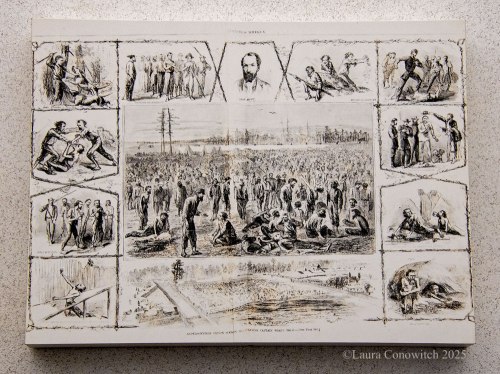
“Ah, my friends, had you been there and experienced the sufferings…you too would have the whole panorama photographed in your memory to remain there to your dying day. – Pvt. Thomas O’Dea, Andersonville prisoner from 1864-1865

Andersonville National Historic Site, Georgia

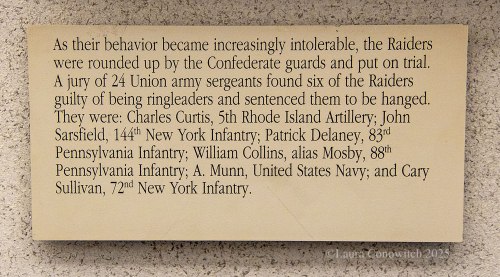
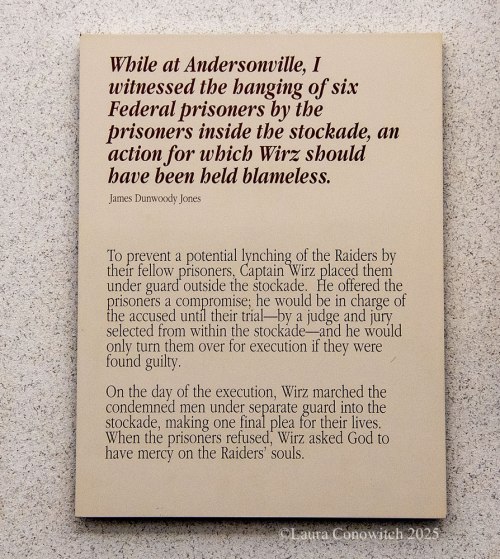
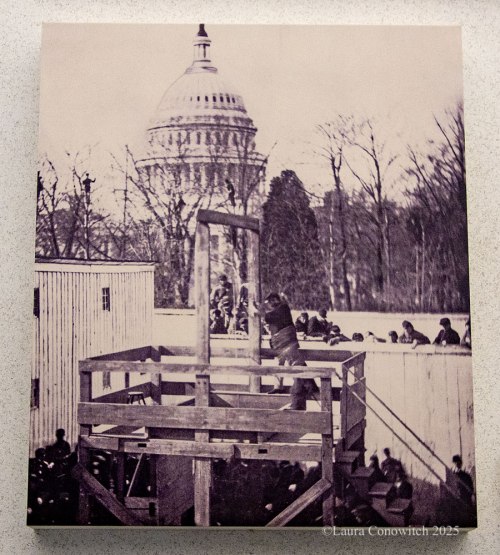
The Raiders’ reign and influence was short lived. The first prisoners began to arrive in late February 1864, and gangs that would become the Raiders start to appear in May 1864. By the end of June they were arrested, and the six leaders were hung on July 11, 1864 – a full month before the prison would be at its worst. At the time the Raiders were arrested, there had been fewer than 3,000 deaths in the prison – meaning that some 10,000 prisoners died after the Raiders’ reign ended.

Andersonville National Historic Site, Georgia

The Raiders leaders were Charles Curtis, John Sarsfield, Patrick Delaney, Teri Sullivan (aka “WR Rickson”, according to other sources), William Collins, and Alvin T. Munn.

Andersonville National Historic Site, Georgia

Andersonville National Historic Site, Georgia

“I would rather be hanged than live the way most prisoners have to live.” – Eyewitness account of Delaney’s last words

Andersonville National Historic Site, Georgia

General Lew Wallace was the president of the military commission that tried and convicted Captain Henry Wirz, the commander of the Confederate Andersonville Prison, after the Civil War. Wallace presided over the trial in August 1865, which found Wirz guilty of war crimes related to the horrific conditions at the prison. He was subsequently sentenced to death and hanged in November 1865.

Andersonville National Historic Site, Georgia

Andersonville National Historic Site, Georgia

Andersonville National Historic Site, Georgia

Andersonville National Historic Site, Georgia

See the world around you!

More Travel Posts:

Cross Country Vacation Sept./Oct. 2025-Post 13

Monterey Square, Savannah, Georgia

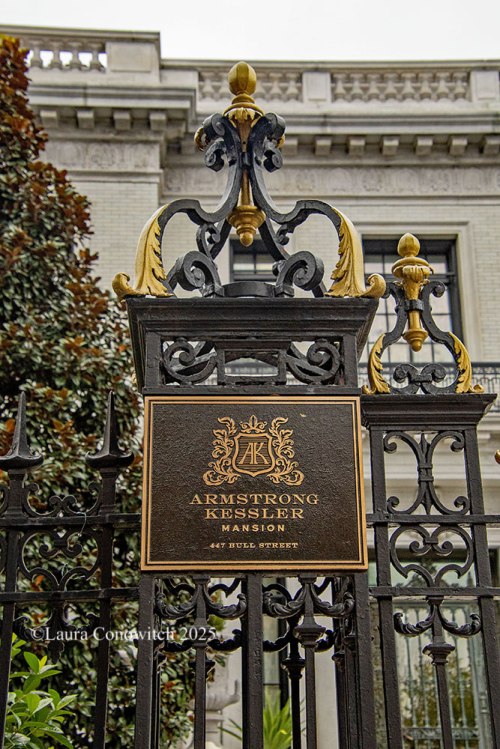
The Hubster and I took a walk in parts of Savannah and enjoyed taking in the archictecture and sights of the area that we were in. We passed by the very ornate Armstrong Kessler Mansion on our walk in the historic district.

Armstrong Kessler Mansion, Savannah, Georgia

*Clicking on a photo will give you a closer look!

Armstrong Kessler Mansion, Savannah, Georgia

Armstrong Kessler Mansion, Savannah, Georgia

Armstrong Kessler Mansion, Savannah, Georgia

Armstrong Kessler Mansion, Savannah, Georgia

Monterey Square was laid out in 1847 and commemorates the 1846 Battle of Monterey during the Mexican American War.

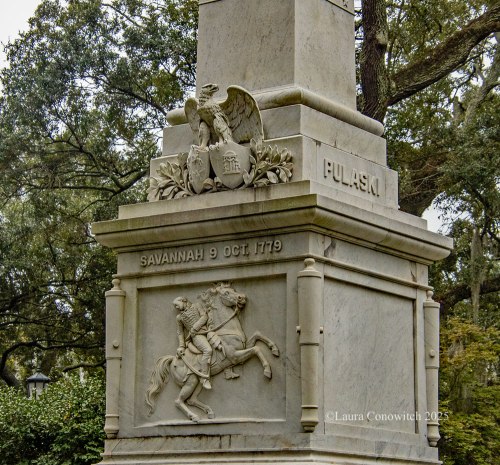
The Casimir Pulaski Monument in the center of the square honors General Pulaski. The monument was erected in 1853. During the Siege of Savannah in the American Revolution, October 1779, the young Polish nobleman died as a result of a gunshot wound. The body of an unknown Revolutionary soldier, speculated by some to be General Pulaski himself, is said to be buried beneath the monument. There have been several tests, including DNA, that make for a very good case that this is Pulaski, but there is still controversy. There is also controversy as to whether Pulaski was male or female.

Pulaski Monument, Monterey Square, Historic District, Savannah, Georgia

“I came here, where freedom is being defended, to serve it, and to live or die for it.” – General Casimir Pulaski to General George Washington in 1777.

Pulaski Monument, Monterey Square, Historic District, Savannah, Georgia

The designer of the monument, which is of Italian marble, was the eminent Russian-born sculptor, Robert Eberhard Launitz of New York. At the conclusion of his explanation of the elaborate design and its symbolism Mr. Launitz stated:

“The monument is surmounted by a statue of Liberty, embracing with her left arm the banner of the Stars and Stripes, while in her right hand is extended the Laurel Wreath. The love of liberty brought Pulaski to America; for love of liberty he fought, and for liberty he lost his life. Thus, I thought that Liberty should crown his monument, and share with him the homage of the free.”

Pulaski Monument, Monterey Square, Historic District, Savannah, Georgia

Pulaski Monument, Monterey Square, Historic District, Savannah, Georgia

The Greek and Italian style Mercer-Williams House was designed by John S. Norris and erected in 1871. It was commissioned by General Hugh W. Mercer, grandfather of the renowned songwriter Johnny Mercer, in the year 1860.

Mercer-Williams House has been surrounded by mystery and death. In 1913, the owner at that time tripped over the second floor banister, suffering only mild injuries but strangely died three days later. Later on in 1969, a young boy chasing pigeons on the roof fell over the edge and impaled himself on the iron fence below. The story, ‘Midnight in the Garden of Good and Evil’ by  John Berendt, revolves around this house (I have the book but haven’t read it yet). The book, was published in 1994 and follows the story of Jim Williams, an American antiques dealer and a historic preservationist, on trial for the killing of his lover, Danny Hansford. After four trials, Williams was acquitted of Hansford’s murder.

The house showcases Philadelphia red brick facade with elegant cast iron balconies and French windows as well as eight balconies and forty windows throughout its impressive structure. Inside the house is a large, eclectic collection of original paintings, furniture, and art pieces, including 18th and 19th century English and American portraits and Chinese porcelain.

The Hubster and I took a tour of this home, but we were not allowed to take photos. I can say that we enjoyed the tour of this beautiful home and the garden.

Mercer Williams House, Monterey Square, Historic District, Savannah, Georgia

“What I enjoy most,” he said, “is living like an aristocrat without the burden of having to be one.” – Jim Williams

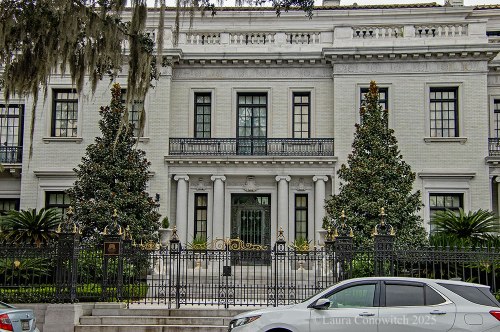
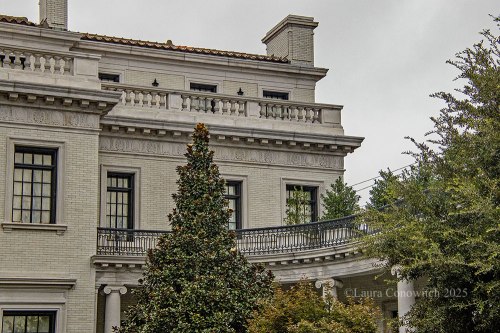
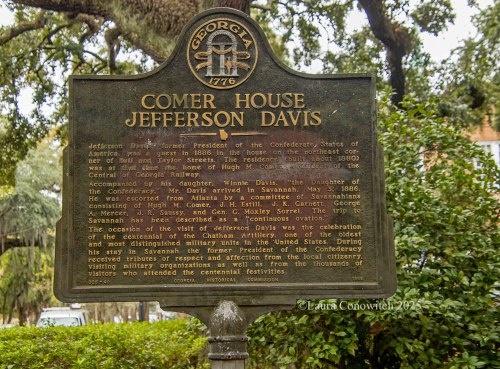
The Comer Mansion on Monterey Square, formerly the home of Hugh Moss Comer , President of the Central of Georgia Railway, was built in 1880.

Comer House, Monterey Square, Historic District, Savannah, Georgia

The house is notable for its elegant architecture and its role in hosting distinguished Confederate dignitaries during the late 19th century.

In 1886, Jefferson Davis, former president of the Confederate States of America, with his daughter Varina Anne Davis, resided here while celebrating the centennial of Savannah’s Chatham Artillery.

Comer House, Monterey Square, Historic District, Savannah, Georgia

The Gothic Revival Green-Meldrim Mansion was designed by John S. Norris and built by Charles Green, one of Savannah’s richest cotton merchants, in 1850. It has a stuccoed brick exterior, cast-iron porch, oriel windows, and an imposing front cast-iron fence. The main entrance has an iron portico believed to be unique in the United States.

After the Union troops captured Savannah in 1864, and at the invitation of Charles Green, General Sherman occupied the house and used it as his personal headquarters until the end of the Civil War. In December, Sherman composed his telegram to President Lincoln, in which he communicated his desire to present to the President “as a Christmas Gift the City of Savannah, with one hundred and fifty heavy guns and plenty of ammunition, and also about twenty-five thousand bales of cotton”; the cotton belonged to Charles Green, the owner of the house.

Green-Meldrim Mansion, Monterey Square, Historic District, Savannah, Georgia

Susie Baker King Taylor,  born into slavery in 1848, later a freed African American woman who worked for the Green family, was the first and only woman to publish accounts of the Civil War.

She is known for being the first African-American nurse during the American Civil War, the first Black woman to self-publish her memoirs (She was the author of Reminiscences of My Life in Camp with the 33rd United States Colored Troops, Late 1st S.C. Volunteers – 1902.), and as an educator to formerly bonded Black people in the Reconstruction-era South when she opened various Freedmen’s schools for them.

Green-Meldrim Mansion, Monterey Square, Historic District, Savannah, Georgia

Green-Meldrim Mansion, Monterey Square, Historic District, Savannah, Georgia

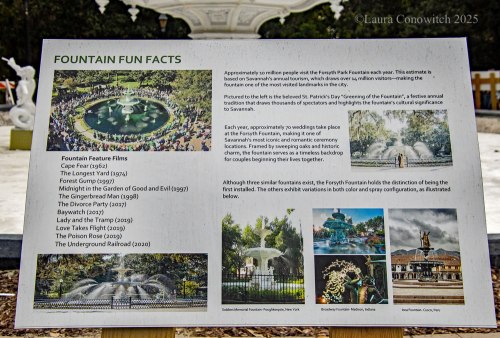
Forsyth Park, Savannah’s oldest and largest park at 30 acres, was fun to walk about. There were artisans of all types; jewelry makers, painters, fortune tellers, and so many more, lining the walkways around the Fountain. There were people jogging, dog walking, and picnicking. There were the sight-seers, like myself.

A busy and happy place!

Forsyth Park, Historic District, Savannah, Georgia

Unfortunately, for our visit, the Forsyth Park Fountain was undergoing preservation and restoration, and we did not get to see it in all of its glory. The fountain is over 150 years old! It was originally built to provide clean drinking water to the citizens of Savannah.

Forsyth Park, Historic District, Savannah, Georgia

Forsyth Park, Historic District, Savannah, Georgia

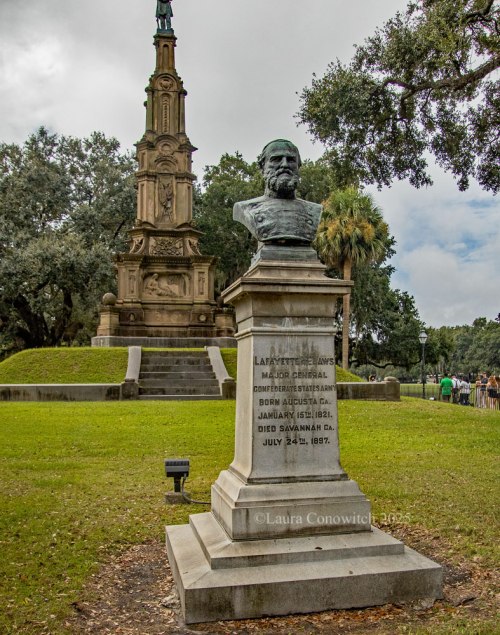
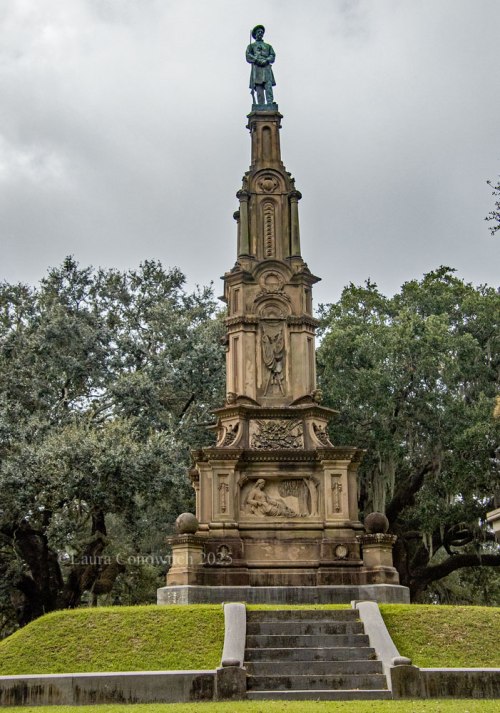
Originally known as the Confederate Monument, the Civil War Memorial stands at 48 feet tall and is topped with a bronze statue of a Confederate soldier. It was dedicated in 1875 to honor Confederate soldiers who died during the Civil War.

In 1910, two bronze busts honoring Confederate generals Lafayette McLaws and Francis S. Bartow were moved next to the monument.

Civil War Memorial, Forsyth Park, Historic District, Savannah, Georgia

The Ladies Memorial Association, in charge of the monument, and raising the funds for the monument, unanimously decided that the memorial must not arrive from the northern United States: tensions between the American North and South were still high, and a monument commissioned to a northerner felt inappropriate. They also did not allow the use of Northern ports. The Ladies Memorial Association also determined Forsyth Park as the location for the monument.

Civil War Memorial, Forsyth Park, Historic District, Savannah, Georgia

There was considerable controversy over the design of the monument. Many did not like the symbolism and funerary elements and considered it artistically offensive. Changes to the original design were made, including changing the name from the Confederate Monument to the Civil War Memorial.

Civil War Memorial, Forsyth Park, Historic District, Savannah, Georgia

“Blow from the four winds, o breath, and breathe upon these slain that they may live.” – Inscription

Civil War Memorial, Forsyth Park, Historic District, Savannah, Georgia

See the world around you!

More Travel Posts: