
I thought since I am immersed in ‘canning season’, I would share a letter that I sent to my daughter and daughter-in-law when I was asked how to can.
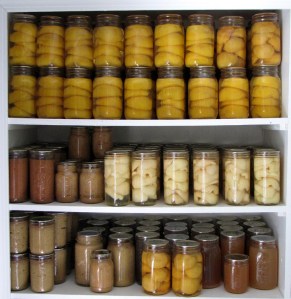
Mom’s Method of Canning Peaches, Pears and Nectarines
* Do not let small children (and maybe husbands) participate in this activity (I burn myself every time).
** Do not have a manicure before this activity either.
*** Allow yourself an all night marathon, or a couple of hours everyday to complete this activity (this is assuming that you have ordered as much fruit as I tend to, whether you need it or not).
Gather your equipment:
Old towels Water-bath canner with a rack and a lid Large and small saucepans Plastic pitcher Jar lifter Timer Ladle Butter knife (The experts say to use a rubber spatula, but mine won’t fit. I don’t remember why we aren’t supposed to use metal to remove the bubbles; something about a chemical reaction – maybe turns the fruit brown? Anyway, I don’t do what the experts say in this instance.)
Wide mouth jars (You can use the skinny ones, but your hand won’t fit into them.)
Jar lids and rings to fit your size jars (seven quart jars fit my canner)
Dry measuring cup Teaspoon (Or just fake it.) Paring knife; or your favorite for peeling and cutting Sharpie (or some permanent marker)
Other stuff:
Fruit (see title) Lots of water Sweetener (or not) White vinegar Cream of tartar
The previous two items are optional (actually the previous three, but I’m talking about the previous two right now). I use these together to prevent my canner from turning black, and to prevent mineral buildup on my jars. I want my jars to sparkle and be pretty to look at. After all, I worked hard enough for them. It is entirely possible that either the vinegar, or the tartar, will do the job alone, but I like the security I guess. You could experiment, and save some money, as cream of tartar can be expensive. I don’t measure when I use them, but you might want to use the teaspoon to drop in a half-spoon or so. I don’t measure the vinegar, either, but start with a tablespoon’s worth of pour or so. Don’t worry, if your pot turns black, just use more the next time; it’ll clean up beautifully.
Some other optional stuff – food coloring (red and green for Christmas) and flavorings (try mint, or cinnamon, for example).
1. Fill canner half full of water. Add the vinegar/cream of tartar at this time as well. Turn the heat on so you won’t crack a jar when placing a hot jar into cold water. By the way, place that jar in slowly so it’ll adjust to the temperature. Should a jar break, do not even think about rinsing the fruit and keeping it for eating. Do not do it! I know you worked hard on that fruit, but throw it away, along with that broken jar!
2. Fill large saucepan full of water. Add the optional sweetener to taste. This is experimentation for you. I tend to measure out 1 cup of white sugar to a pot of water, or (I can’t remember now) about a half-cup of honey. There are all kinds of flavored honey, so you really do have to figure this out for yourself. Boil the water.
3. I bring seven jar lids to a boil (and then keep them hot) in the small saucepan. So, yeah, put water in here too.
4. While all that boiling is going on, you can be peeling your fruit. I don’t peel the nectarines (too lazy – just tell people that the skins are full of antioxidants; or don’t serve ‘em to anybody but yourself), but you can peel yours. I thought about not peeling the pears either, but didn’t think they’d be as nice. Maybe I’ll try that sometime. And I never think about not peeling the peaches – I don’t want hairy skins in my jars. Gross!
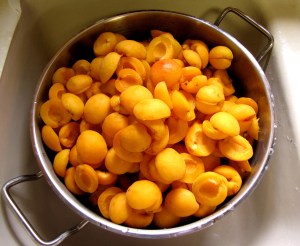
5. Cut the fruit in half and get rid of the pit. You could cut it in half first, and then peel. I don’t care.
6. Raw pack into the jars.
7. Ladle the syrup (it should be a syrup now, if you added sweetener) over the fruit. Careful here! It is easy to miss the jar and pour boiling water on yourself! Also, stop adding syrup when you are within an inch of the top of the jar. The liquid will expand and make a mess in your canner, if you overfill the jars.
8. Use the butter knife (or rubber spatula) to work out the air bubbles. Just run it down the inside of the jar.
9. Put the lid and ring on the jar.
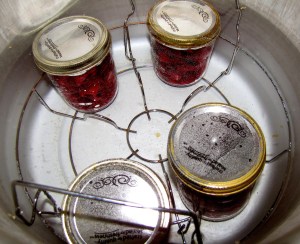
10. Put the jar (slowly) into the hot water bath. Add enough water to cover an inch above the tops of the jars.
11. When the water bath is loaded, bring it to a boil, and boil for 25 minutes (set the timer). Do not think about skimping here; you don’t want to give your family botulism!
12. Work on loading the next set of jars while you wait. Or you could take a break, but you’ll never get done if you keep taking all those breaks.
13. Oh yeah, layer two old dish towels on your counter. This is to protect your counter if you care. Also, I just like the insurance of not setting hot jars onto cold counters.
14. When the timer goes off, use the jar lifter, and your dish rag, to take out the jars and put onto the towels. Notice how the syrup is running all over?
15. Use the pitcher to remove at least half of the hot water from the water bath. Replace with cold water and more vinegar/cream of tartar. Now you can reload, assuming you didn’t take a break and you have another load ready. Gradually bring to a boil, so as not to break a jar. One does occasionally break, but you don’t have to help it along.
16. About those jars that are cooling on the counter. I don’t let them cool for long before I take the rings off and wipe down the jars. Definitely wait until the jars seal (you can sometimes hear the lids ‘pop’, but a better test is to push down on the lids. The lid should not pop back up in the center (if they do, wait overnight. If they still haven’t sealed, eat the fruit right away; again, we don’t want to poison the family with botulism). Here’s why I remove the rings – I have childhood memories of unfulfilled peach cravings because I could not loosen a ring that has been glued to the jar by petrified syrup (I, and my sisters, were creative in working these rings loose). My Mother may have done that on purpose – to protect her investment. My investment is so large that I don’t need to worry about it.
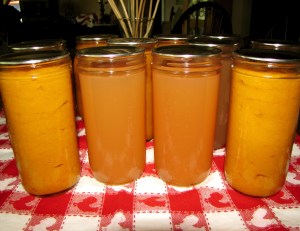
17. Date the jars (I just use a Sharpie right on the lid). Wait overnight (to be sure of the seal) and store them where you can admire your handiwork. By the way, like everything else, keep away from sunlight. Yes, the sun will fade the color. The color will fade over time, but why rush it. Eat within the year, and you won’t notice a color change.







 LC's Cottage