
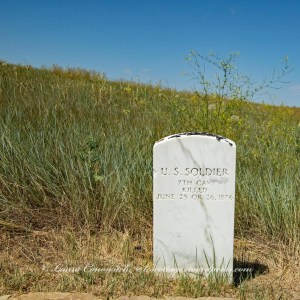
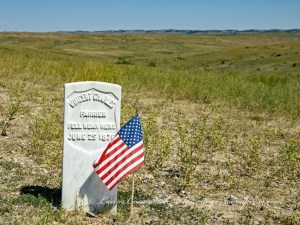
There are many memorial markers throughout the battlefield; red for the Indians and white for the civilians and soldiers. Trails lead to some of them, and others are isolated. Many represent an unknown person who had fallen in that spot.
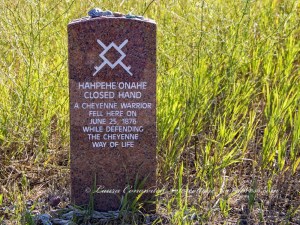
*Clicking on a photo will give you a closer look!
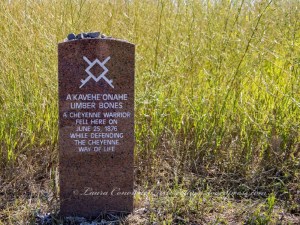
It is heartbreaking to see these markers everywhere.
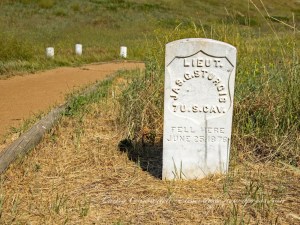
In the following photo, you are near Last Stand Hill. As you look towards the tree line and the Little Bighorn River, you are astonished at a very large Indian encampment.

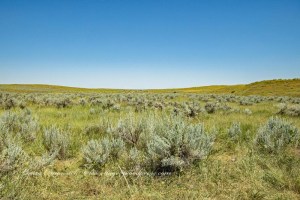
I am sharing photos of the terrain, so that you can get an idea of it. Remember that I said that we visited on July 28…not too distant from the anniversary date of June 25-26. It is summer and it is hot. I found myself overheating even with taking my time to walk and drinking plenty of water.
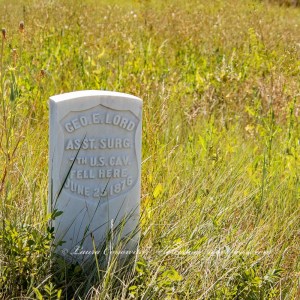
I am imagining what it must have been like for the warriors and soldiers, and civilians. Can you picture being in full gear, crawling along a rattlesnake and cactus infected ground, and under the full heat of the sun, trying to avoid a bullet or a hatchet? How about the sounds of artillery and the screams of fear and rage? What about the horror of seeing the fallen all around you?
Terrifying.
They were in hell.
Deep Ravine (Crazy Horse Gully and Grey Horse Ravine) where approximately 40 soldiers were killed.
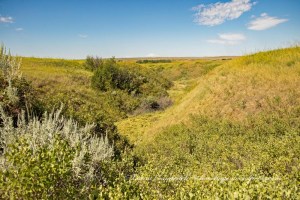
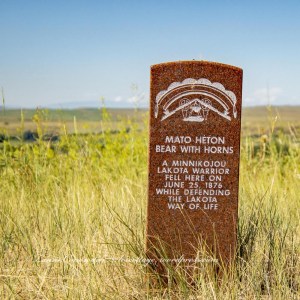

Perhaps as many as 600 warriors pursued Major Reno’s retreat across the river at this spot. Reno’s casualties are 40 men killed and 13 wounded.
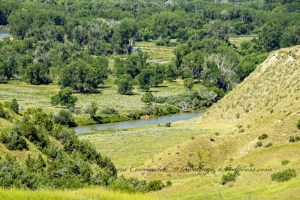
Reno Hill, also known as the Reno/Benteen Battlefield where the field hospital was. Soldiers volunteered to make the treacherous trek while under fire, to get water for the wounded.
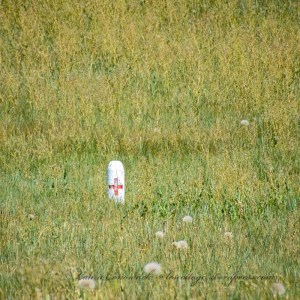
Medicine Tail Coulee where Custer divided his command.
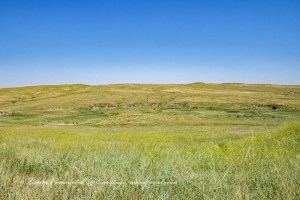
Warriors pursued Custer’s retreat up Deep Coulee to the high ground.
If you are interested in this period of American history, then you will find it worth your time to visit Little Bighorn Battlefield National Monument Park.
Little Bighorn Battlefield National Monument Park Part 1
See the world around you!




 LC's Cottage
I was in High School (in Colorado) in the early 70s. A group of students from a history/sociology class were part of a field trip to Pine Ridge Reservation in SD. While I was not one of them, I still clearly remember this chapter of my own education. https://www.nationalgeographic.com/history/article/what-really-happened-at-wounded-knee-the-site-of-a-historic-massacre The Wounded Knee Massacre took place in 1890…14 years **after** Little Bighorn.
I didn’t realize that until my first visit to Little Bighorn during college over Spring Break a few years later.
A friend & I visited another friend who lived in Montana and we visited the Memorial. At the time, there were Zero references to the Native American perspective…I almost got physically ill as I was overwhelmed by that fact coupled with the glorification of Custer; being on the site and viewing the vastness of the tribal landscape.
All that to say, I am relieved you were able to depict a mini-balance of your visit with these new (to me) markers of individuals ‘defending their way of life.’
While your photos are gorgeous because of the landscape itself, they also evoke a sense of respect for the land, its history and its people IMHO.
LikeLiked by 2 people
Thank you so much, Laura. I really wanted to convey the rugged, yet, beautiful landscape and what took place here. I believe that these types of monuments/parks deserve much respect. They are cemeteries for one thing, and they represent so many who fought and died to protect their values. Too much history to share in a blog post…that is why books and field trips are necessary.
The Hubster and I brought our small children here back in the early 90’s (or maybe it was the late 80’s). At that time, I think we were the only ones visiting and the park was different. I am so glad that we went back…it is much better now. Well laid out, and well depicted as to what is known to have happened here.
Unfortunately, there have been many more battles and massacres since.
LikeLiked by 3 people
Hi Laura. That one headstone just speaks so loudly and deeply to me. A warrior died here defending their way of life. Our country’s history has always been rich white men taking advantage of non-rich or not privileged folks to further their wealth. The colonies were settled to get away from the monarchy and to practice their own religion, yet those same individuals forced their way of life on the natives. It really disgusts me, to be honest. I have to add that these are just my opinions – I’m not up for a political discussion. The slogan, home of the brave and the free? It’s a misnomer. It’s really all about who has the most money and who yells the loudest. Does that represent brave and free? Way too deep for a Friday night, but thank you, again, for the wonderful pictures and taking us along on your journey. {{Hugs}} ~smile~ Roseanne
LikeLiked by 1 person
Rosanne…our thoughts and values aren’t all that different, I don’t think. I spent last winter studying the colonists because I was researching family history. I learned that we are descended from Governor Bradford and Susannah North. Those two, and others, made me really want to understand the times. There was a lot of persecution way back then in the land of the free. Persecutions of all types. By the British. By the French. By the colonists on other colonists. By the Indians to the colonists and by the colonists to the Indians. Freedom of religion? Never happened. I have Quaker ancestors that were whipped and jailed. Others died from banishment and starvation.
The list goes on. Different times but greed, etc. remain.
I know that you are doing your best to educate your littles and show them what love is. I am doing the same for mine. Your post about love is spot on! Hugs to you, too! 🙂
LikeLiked by 2 people
The “new” Little BigHorn Monument is much more honest. I always thought that General Custer was more concerned about clothes and looking good than his men. His decisions at LBH showed that. The Cheyenne and Lakota were truly fighting for their way of life, and they planned accordingly. While there’s no changing history, healing does not happen without honesty on both sides. When we moved here to the Dakotas 35 years ago I had no concept of how our Indian friends felt (that’s the term they encouraged me to use by the way….many feel that using Native American is merely a way to white wash!) much prejudice toward any white person. I spent lots of time on Pine Ridge working to open an after school center, and our group learned together that we need to accept the past and build relationships in the now. It started when I asked If they blamed me (my ancestors) for what happened, and some said of course. I explained that I was only a 3rd generation from Norway, and that my grandparents hadn’t even arrived when all this happened. That opened the door for a lot of dialogue, and honesty that served us well for many many years. I tell the story for the benefit of others reading the comments. We learned together that you have to take each person individually, no matter what their color or background!
LikeLike
Loved reading your comments and experiences, Kathy! You are so right…we must start with now; can’t do anything about the past. My first grandson is half Cherokee. It was my pleasure to share his family history with him, and he was quite excited about it. I have a cousin who is half Lakota. She ignores the part about being half white and that all her cousins are white. She heads up a ‘Native American’ magazine, and lots of it is about how bad the whites were/are. Her Facebook page is full of name calling, and yet, she would agree that we should all love one another. Prejudice permeates every race…it isn’t in the skin color. It is in the mind.
LikeLiked by 1 person
Exactly!
LikeLiked by 1 person
Thank you so much for sharing…the photos and the history!
LikeLike
Thank you for stopping by, Connie! I really appreciate it! 🙂
LikeLike
Thank you for sharing. I don’t know that I will ever get there, but I am moved by it. The loss of life, the conditions, and the newer recognition of honoring all who fought for their rights is touching. It moves me that we are being able to be more honest about all sides involved – and that each had beliefs they were fighting for and acknowledge the wrong were people were wrong. If we evolve, so do our understandings, and that is a good thing.
LikeLike
Thank you, Kathleen! Looking at all perspectives and understanding is so very important! 🙂
LikeLike
Thank you! Enjoyed reading about this Park,also agree with Kathy’s comment.
LikeLike
Thank you, Deb! 🙂
LikeLiked by 1 person
This is an amazing park and slice of our countries history. I read thru some comments and your dialog with Kathy…having taught 20 years at Ferndale HS with many of the Lummi Nation at our school I can add – totally agree – its in the mind not the color 🙂
LikeLike
Thank you, Sharon! I did not expect so much dialog, but I definitely appreciate it! 🙂
LikeLiked by 1 person
There’s nothing like visiting historic sites to really get a feel for what it was like to be there. Thank you for the atmospheric photos and sharing your thoughts of what it must have been like for all those involved in such tumultuous events.
LikeLike
The best way to learn history is to be where the event happened, if possible, I think…to try to place one’s self there. History classes ought to have more field trips! 🙂
LikeLike